
Hybrid Battery Repair & Replacement Services in Islamabad
Your hybrid battery is the most expensive and critical component in your hybrid vehicle. When it starts failing – showing the dreaded red triangle warning, losing power, or dramatically reducing your fuel economy – you need specialists who truly understand hybrid technology.
At Auto Surgeon Workshop, we’re not just general mechanics dabbling in hybrids. We’re genuine hybrid vehicle specialists with professional diagnostic equipment, years of experience, and hundreds of successful hybrid battery repairs and replacements under our belt.
Whether you drive a Toyota Prius, Honda Vezel, Toyota Aqua, Honda Fit Hybrid, or any other hybrid vehicle, we can diagnose your hybrid battery accurately, explain your options clearly, and provide the most cost-effective solution for your specific situation.
Don’t let another workshop tell you “just replace it” without proper diagnosis. Often, your battery can be repaired for a fraction of replacement cost.
📞 Call Now: 0342-9810577 | 📅 Book Appointment | 💬 WhatsApp Us
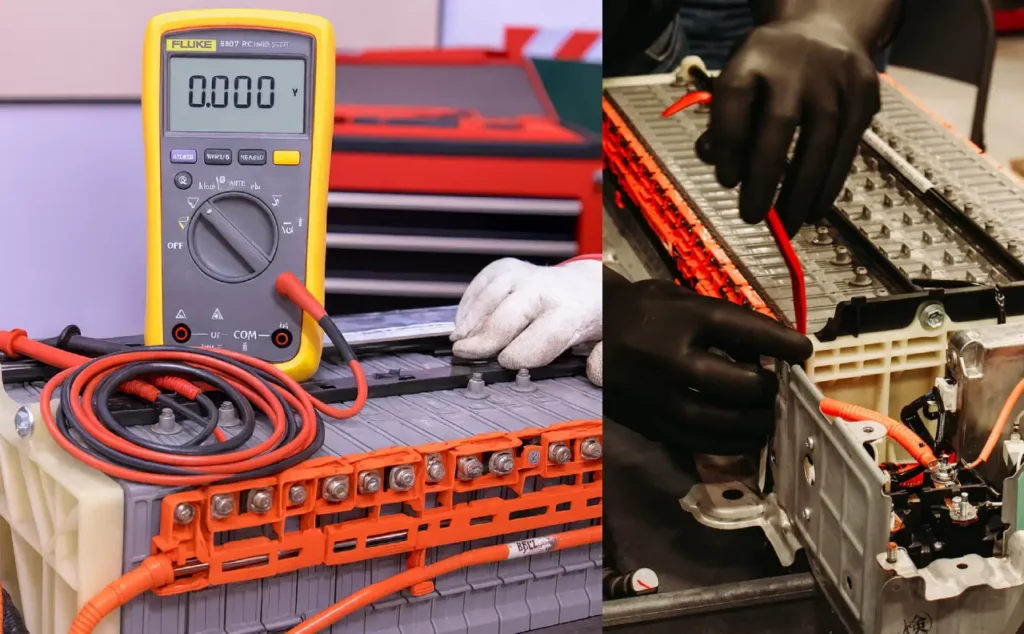
Understanding Hybrid Battery Technology
Before we talk about repairs and replacement, let’s understand what we’re dealing with.
What is a Hybrid Battery?
Unlike your regular 12-volt car battery, your hybrid battery is a high-voltage system (typically 200-300 volts) that:
- Powers the electric motor for acceleration and propulsion
- Stores energy from regenerative braking
- Assists the gasoline engine for better efficiency
- Operates in extreme conditions (hot summers, cold starts)
- Contains multiple modules working together as one unit
Most hybrid batteries aren’t actually one battery – they’re a pack of 20-40 individual modules connected in series. This is crucial to understanding repair options.
Common Hybrid Battery Types:
Nickel-Metal Hydride (NiMH):
- Used in most Toyota Prius, Aqua, and older Honda hybrids
- Proven reliability (many last 200,000+ km)
- Can be reconditioned successfully
- More tolerant of Pakistan’s climate
Lithium-Ion (Li-ion):
- Used in newer hybrids and plug-in hybrids
- Lighter weight, more energy dense
- More sensitive to heat
- Generally more expensive to replace
How Hybrid Batteries Fail:
Hybrid batteries rarely fail all at once. Instead:
- One or more modules weaken over time
- The weak modules can’t keep up with stronger ones
- The battery management system detects imbalance
- Warning lights appear (red triangle, check hybrid system)
- Performance degrades (reduced power, poor economy)
- Eventually, vehicle enters “limp mode” or won’t start
The good news? If caught early, we can often repair the battery by replacing or reconditioning just the weak modules instead of replacing the entire pack.
Signs Your Hybrid Battery is Failing
Early Warning Signs:
- Reduced fuel economy (your hybrid isn’t as efficient as it used to be)
- Less power during acceleration
- Battery gauge fluctuating more than normal
- Engine running more than it used to
- Longer time to charge the hybrid battery
- Fan running loudly or constantly
Severe Symptoms:
- Red triangle warning with multiple alerts
- Drastically reduced power (can barely accelerate)
- Vehicle won’t start
- Hybrid system disabled
- “Pull Over Safely” message
- Complete loss of hybrid function
Moderate Symptoms:
- Check engine light with hybrid-related codes (P0A80, P3000, P0A0F, etc.)
- Triangle warning light (yellow or red)
- “Check Hybrid System” message
- Battery charge not holding as well
- Noticeable power loss
- Rough transitions between electric and gas
Important: The earlier you address hybrid battery issues, the more repair options you have and the less expensive it becomes.
Our Hybrid Battery Services
1. Professional Hybrid Battery Diagnostics
What We Test:
Unlike basic code readers that just tell you there’s a problem, our professional hybrid diagnostic equipment provides:
Module-by-Module Testing:
- Individual voltage readings for each battery module
- Capacity testing under load
- Internal resistance measurements
- Temperature monitoring
- State of charge analysis
System-Wide Analysis:
- Battery management system function
- Cooling system effectiveness
- Charging system performance
- Hybrid control computer status
- High-voltage circuit integrity
Real-World Load Testing:
- How battery performs during acceleration
- Regenerative braking efficiency
- Module balance during charge/discharge
- Thermal management under stress
Our Diagnostic Report Includes:
- Color-coded module health chart
- Specific modules that are weak or failing
- Overall battery pack condition assessment
- Remaining useful life estimate
- Repair vs. replacement recommendation
- Detailed cost breakdown for options
Why Proper Diagnosis Matters:
Many workshops will see hybrid battery codes and immediately recommend full replacement But often, only 1-3 modules need attention.
Without proper testing, you might pay for a full battery when a targeted repair would work perfectly.
2. Hybrid Battery Module Replacement
What is Module Replacement?
Since hybrid batteries are made of multiple modules, we can replace just the weak or failed modules instead of the entire pack.
Step 1: Identify Weak Modules
- Comprehensive testing identifies exactly which modules are failing
- Typically 1-5 modules out of 20-40 total
Step 2: Safe Disassembly
- Follow proper high-voltage safety procedures
- Wear insulated gloves and use specialized tools
- Disconnect high-voltage system properly
- Remove battery pack (if required by design)
Step 3: Module Replacement
- Install new or professionally refurbished modules
- Match voltage and capacity specifications
- Ensure proper connections and sealing
- Balance the pack electronically
Step 4: Reassembly & Testing
- Reinstall battery pack securely
- Reconnect high-voltage system
- Perform hybrid system reset and relearning
- Test drive to verify proper operation
- Rescan to ensure no remaining codes
Benefits of Module Replacement:
✅ Much less expensive than full battery (typically 40-60% savings)
✅ Proven effective with proper diagnosis
✅ Extends hybrid battery life significantly
✅ Retains original battery pack components
✅ Quick turnaround (usually same or next day)
Ideal Candidates:
- Batteries with isolated module failures
- Mid-life batteries (5-10 years old)
- Vehicles worth more than full replacement cost
- Owners planning to keep vehicle several more years
Warranty: 6 months on modules and labor
3. Hybrid Battery Reconditioning & Balancing
What is Battery Reconditioning?
Over time, individual modules in your hybrid battery develop different capacities even if none have completely failed. This imbalance causes:
- Reduced overall battery performance
- Premature failure codes
- Decreased efficiency
- Lower power output
Reconditioning restores balance and capacity.
Our Reconditioning Process:
Deep Discharge:
- Carefully discharge entire battery pack
- Monitor each module during discharge
- Identify capacity variations
Individual Module Conditioning:
- Charge and discharge each module individually
- Multiple cycles to restore capacity
- Remove sulfation buildup
- Restore chemical balance
Electronic Balancing:
- Bring all modules to same voltage
- Ensure uniform capacity
- Program battery management system
- Calibrate charge/discharge curves
Final Testing:
- Verify all modules within specification
- Test under load conditions
- Confirm proper charging and discharging
- Road test for real-world performance
Who Benefits from Reconditioning?
- Batteries showing early signs of imbalance
- Preventive maintenance for aging batteries
- After module replacement to optimize entire pack
- Batteries with slight performance degradation
Success Rate: 70-80% show significant improvement
Warranty: 3-6 months depending on battery condition
4. Complete Hybrid Battery Replacement
When is Full Replacement Necessary?
Complete battery replacement makes sense when:
- Multiple modules are failing (more than 30% of pack)
- Battery has been neglected and severely degraded
- Previous repairs haven’t been successful
- Battery is very old (12+ years) with high mileage
- Cost of repairs approaches replacement cost
- You want maximum remaining life
New vs. Refurbished Batteries:
Brand New Batteries:
- Pros: Maximum lifespan, full warranty, best performance
- Cons: Expensive depending on model)
- Best for: Newer vehicles you plan to keep long-term
Professionally Refurbished Batteries:
- Pros: Much less expensive, tested and warranted
- Cons: Not quite as long-lasting as brand new
- Best for: Mid-age vehicles, cost-conscious owners
Our Replacement Process:
- Remove Old Battery Pack
- Disconnect high-voltage system safely
- Remove interior components blocking access
- Carefully extract battery pack
- Dispose of old battery responsibly
- Prepare Vehicle
- Clean battery compartment
- Inspect cooling ducts and fans
- Check all connections and wiring
- Test battery management system
- Install New Battery
- Position new battery pack carefully
- Connect high-voltage cables securely
- Install all safety covers and shields
- Reconnect cooling system
- System Initialization
- Reset hybrid system computers
- Perform battery registration procedure
- Calibrate battery management system
- Clear all fault codes
- Comprehensive Testing
- Verify all systems operational
- Test drive under various conditions
- Monitor charging and discharging
- Ensure proper power delivery
5. Hybrid Battery Cooling System Service
Why Cooling Matters:
Your hybrid battery generates heat during charge and discharge cycles. Overheating is the #1 enemy of battery life.
Most hybrid vehicles use:
- Cooling fans pulling air through the battery
- Air filters preventing dust from entering battery
- Ducting directing airflow where needed
Common Cooling Problems:
- Clogged cooling filters (very common in Pakistan’s dusty environment)
- Failed cooling fans
- Blocked air ducts
- Damaged cooling system components
Our Cooling System Service:
Inspection:
- Check all cooling fans for operation
- Test fan speeds under different loads
- Inspect air filters (often terribly clogged)
- Examine ducting for blockages or damage
Cleaning:
- Replace or thoroughly clean cooling filters
- Clean battery pack cooling fins
- Remove dust and debris from ducts
- Ensure unrestricted airflow
Repair/Replacement:
- Replace failed cooling fans
- Repair damaged ducting
- Replace worn components
- Test system performance
Why This Service is Important: A clogged cooling system can reduce battery life by years. This simple maintenance can prevent expensive battery failure.
Vehicle-Specific Hybrid Battery Information
Toyota Prius (All Generations)
Battery Type: NiMH (Nickel-Metal Hydride) Modules: 28 modules in series Voltage: 201.6 volts nominal Common Issues:
- Module imbalance (most common)
- Cooling fan failure
- Individual cell failure
- Battery management sensor issues
Toyota Aqua (All Models)
Battery Type: NiMH Modules: 20 modules in series Voltage: Approximately 144 volts Common Issues:
- Similar to Prius but smaller pack
- Cooling system more critical due to compact design
- Early warning signs often ignored
Typical Lifespan: 120,000 – 200,000 km
Repair Options:
- Module replacement
- Reconditioning
- Full replacement
Success Rate: Excellent with timely intervention
Special Notes: Aqua batteries respond very well to reconditioning if caught early.
Honda Vezel Hybrid
Battery Type: Li-ion (Lithium-Ion) in newer models, NiMH in older Location: Under cargo floor (space-saving design) Common Issues:
- More sensitive to heat than NiMH
- Battery management system more complex
- Cooling system failures more problematic
Typical Lifespan: 150,000 – 200,000 km
Repair Options:
- Module replacement: PKR 35,000 – 65,000
- Full replacement: PKR 200,000 – 300,000
Success Rate: Good with proper diagnosis
Special Notes: Vezel hybrid systems are sophisticated. Proper diagnostic equipment is essential.
Honda Fit Hybrid / Grace Hybrid
Battery Type: NiMH in older, Li-ion in newer Configuration: Similar to Vezel Common Issues:
- Battery degradation from extended use
- Cooling system maintenance critical
- Intermittent warnings before full failure
Typical Lifespan: 140,000 – 200,000 km
Repair Options:
- Module replacement
- Full replacement
Success Rate: Very good
Honda Civic Hybrid / Accord Hybrid
Battery Type: NiMH in older models Configuration: Located behind rear seat Common Issues:
- Earlier Honda hybrid systems had more problems
- IMA light and check engine light
- Battery life shorter than Toyota equivalents
Typical Lifespan: 100,000 – 150,000 km
Repair Options:
- Module replacement
- Full replacement
Success Rate: Moderate (some models more problematic than others)
Suzuki Swift Hybrid / Other Suzuki Hybrids
Battery Type: Li-ion (mild hybrid system) System: Integrated Starter Generator (ISG) Common Issues:
- Simpler system, fewer problems
- Battery failures less common
- When they fail, usually complete replacement needed
Typical Lifespan: 150,000+ km
Repair Options:
- Usually full replacement
Luxury Hybrids (Lexus, BMW, Mercedes)
Battery Type: Usually Li-ion Configuration: Varies by model Common Issues:
- More expensive components
- Complex battery management
- Dealer-level diagnostics often required
Repair Options:
- Limited module replacement options
- Full replacement
Special Notes: We can diagnose these vehicles but repairs often require specialized parts that can be expensive or hard to source.
Hybrid Battery Maintenance Tips
How to Maximize Your Hybrid Battery Life:
1. Drive Regularly
- Hybrid batteries hate sitting unused
- Drive at least 2-3 times per week
- Take longer drives occasionally (not just short trips)
- Regular use keeps battery chemistry active
2. Avoid Extreme Temperatures
- Park in shade when possible during summer
- Don’t leave car in direct sun for extended periods
- Allow cooling system to work after driving (don’t turn off immediately)
- In winter, allow battery to warm up before aggressive acceleration
3. Maintain Cooling System
- Check/replace cabin air filter regularly (it often cools the battery)
- Clean battery cooling filters every 30,000 km
- Ensure cooling fans are working
- Keep air intake areas clean
4. Monitor Performance
- Pay attention to fuel economy changes
- Watch battery gauge behavior
- Notice any power delivery changes
- Address warning lights promptly
5. Proper Charging Habits (Plug-in Hybrids)
- Don’t leave plugged in at 100% for days
- Use regular charging (not always fast charging)
- Avoid deep discharges regularly
- Follow manufacturer recommendations
6. Professional Inspection
- Annual hybrid health check
- Pre-emptive diagnostics if over 150,000 km
- Address any hybrid-related codes immediately
- Don’t wait for complete failure
7. Driving Habits
- Smooth acceleration and braking
- Use regenerative braking effectively
- Avoid constantly draining battery fully
- Let hybrid system manage itself (don’t try to force EV mode constantly)
Cost Comparison: Repair vs. Replace
Example Scenario: 2012 Toyota Prius with Hybrid Battery Warning
Option 1: Full Battery Replacement (New)
- Warranty: 24 months
- Expected additional life: 150,000+ km
Option 2: Full Battery Replacement (Refurbished)
- Warranty: 12 months
- Expected additional life: 100,000+ km
Option 3: Module Replacement (3 modules)
- Warranty: 6 months
- Expected additional life: 60,000 – 80,000 km
Option 4: Battery Reconditioning
- Warranty: 6 months
- Expected additional life: 40,000 – 60,000 km
Our Recommendation Process:
We consider:
- Current battery condition
- Vehicle age and mileage
- Your planned ownership duration
- Your budget
- Vehicle overall condition and value
For example:
- 2010 Prius with 250,000 km: Module replacement makes sense if you’ll drive it 2 more years
- 2018 Vezel with 80,000 km: Full replacement justified for long-term ownership
- 2013 Aqua with 150,000 km: Reconditioning might be most cost-effective
We’re honest about what makes financial sense for YOUR situation.
Why Choose Auto Surgeon for Hybrid Battery Service?
Genuine Hybrid Expertise
We’re not general mechanics who occasionally work on hybrids. We:
- Specialize in hybrid vehicle service
- Have professional hybrid diagnostic equipment
- Trained specifically in hybrid technology
- Work on hybrid vehicles daily
- Understand Toyota, Honda, and other hybrid systems intimately
Proper Diagnostic Equipment
Our hybrid diagnostic tools can:
- Test individual battery modules
- Monitor real-time voltage, current, and temperature
- Detect imbalances before complete failure
- Access hybrid control systems
- Program and calibrate battery management systems
Most workshops lack this equipment and can only read basic codes.
Cost-Effective Solutions
We don’t automatically recommend the most expensive solution:
- Proper diagnosis often reveals less expensive repair options
- We explain all options with honest pros and cons
- Module replacement saves 50-60% vs. full replacement when appropriate
- We help you make the most economical choice
Transparent Pricing
You’ll know exactly what you’re paying for:
- Detailed written estimates
- No hidden charges
- Clear explanation of what’s included
- Options at different price points
- No pressure to choose expensive option
Quality Work & Warranty
- Follow proper high-voltage safety procedures
- Use quality replacement modules
- Warranty on all hybrid battery work
- Thorough testing before return
- Stand behind our repairs
Hundreds of Successful Repairs
We’ve repaired hybrid batteries in:
- Over 200 Toyota Prius vehicles
- Dozens of Honda Vezels and Fit Hybrids
- Many Toyota Aqua vehicles
- Various other hybrid models
Our experience means we can solve problems others can’t.
Hybrid Battery Myths vs. Reality
Myth 1: “Hybrid batteries only last 5 years” Reality: Most last 8-12 years or 150,000-250,000 km with proper care. We regularly see Toyota hybrids with original batteries at 200,000+ km.
Myth 2: “When hybrid battery fails, you must replace the whole pack” Reality: Often only 1-3 modules are bad. Replacing just those modules is effective and much less expensive.
Myth 3: “Hybrid battery replacement costs more than the car is worth” Reality: Full replacement is expensive (PKR 150,000-250,000), but module replacement usually makes economic sense.
Myth 4: “You can’t repair hybrid batteries, only replace” Reality: With proper equipment and expertise, many hybrid batteries can be successfully repaired through module replacement or reconditioning.
Myth 5: “Used hybrid batteries are unreliable” Reality: Properly tested, refurbished hybrid batteries with warranty can be excellent value. We only install refurbished batteries we’ve personally tested.
Myth 6: “Hybrid batteries die suddenly without warning” Reality: They usually give warning signs for months – reduced fuel economy, less power, battery gauge changes. Most owners ignore these signs.
Myth 7: “Extreme Pakistani heat kills hybrid batteries quickly” Reality: Heat does stress batteries, but proper cooling system maintenance prevents premature failure. Many hybrids in Pakistan last just as long as in cooler climates.
Myth 8: “Once you get the red triangle, your hybrid battery is destroyed” Reality: The red triangle is a warning, not a death sentence. Many vehicles with this warning can be successfully repaired.
Frequently Asked Questions
Q: How do I know if my hybrid battery is failing?
A: Watch for these signs:
- Reduced fuel economy (MPG drops significantly)
- Less power, especially on acceleration
- Battery gauge fluctuating more than normal
- Engine running more than it used to
- Warning lights (check hybrid system, triangle warning)
Q: How long should a hybrid battery last?
A: Depends on:
- Vehicle model (Toyota generally longer than Honda)
- Driving conditions (city vs. highway, hot climate)
- Maintenance (cooling system care)
- Typical range: 150,000-250,000 km or 8-12 years
Q: Can I still drive with a hybrid battery warning light?
A: Usually yes, but:
- Yellow warning: Can drive, but schedule diagnosis soon
- Red warning: Limited power, drive carefully to service
- Flashing red/multiple warnings: Pull over safely, call for service Don’t ignore warnings – problems worsen and become more expensive.
Q: Is module replacement as good as full battery replacement?
A: When done properly with good modules, yes for near-term (60,000-80,000 km). Full replacement gives longer life but costs 3-4x more. Choice depends on your situation.
Q: How much does hybrid battery repair cost?
A: Depends on what’s needed:
- Diagnostics: PKR 3,000
- Module replacement: PKR 25,000-60,000
- Reconditioning: PKR 35,000-50,000
- Full replacement: PKR 150,000-400,000 depending on model
Q: Do you offer warranty on hybrid battery work?
A: Yes:
- Module replacement: 6 months
- Reconditioning: 3-6 months depending on condition
- New battery: 12-24 months
- Refurbished battery: 6-12 months
Q: Should I replace or repair my hybrid battery?
A: Depends on:
- How many modules are failing
- Your vehicle’s age and value
- How long you plan to keep it
- Your budget We’ll give honest recommendations after diagnosis.
Q: Can hybrid batteries be reconditioned?
A: Yes, with varying success rates:
- Best for early signs of degradation
- 70-80% show significant improvement
- Not effective for severely damaged batteries
- Works better on NiMH than Li-ion
Q: What kills hybrid batteries?
A: Main culprits:
- Clogged cooling system (dusty environment)
- Extreme temperatures without proper cooling
- Sitting unused for long periods
- Old age and high mileage
- Previous damage from overheating
- Poor maintenance
Q: Can I replace my hybrid battery myself?
A: Strongly not recommended:
- High voltage (200-300 volts) is dangerous
- Special tools and safety equipment required
- Battery management system programming needed
- Improper installation can damage other systems
- Warranty void if not professionally installed
Q: Where does Auto Surgeon get replacement battery modules?
A: We source from:
- Professional refurbishers with testing/warranty
- Tested modules from known-good donor batteries
- New OEM modules when appropriate
- All modules tested before installation
Q: My mechanic says my hybrid battery can’t be repaired, only replaced. Is this true?
A: Not usually. Bring it for a second opinion:
- Most batteries can be repaired if caught reasonably early
- Shops without hybrid expertise often don’t attempt repairs
- Replacement is easier but much more expensive
- Proper diagnosis reveals repair options
Q: How long does hybrid battery repair take?
A: Typical times:
- Diagnostics: 2-3 hours
- Module replacement: 4-6 hours (same/next day)
- Reconditioning: 1-2 days
- Full replacement: 4-8 hours (same/next day usually)
Emergency Hybrid Battery Service
Hybrid System Problems? We Can Help Fast:
✅ Same-day diagnostics when possible
✅ Emergency appointments available
✅ We’ll tell you if it’s safe to drive
✅ Can often repair within 24 hours
✅ Open 24/7 including holidays
If you see warning lights:
- Note which lights and messages appear
- Pay attention to how car is running
- Call us to describe symptoms: 0342-9810577
- We’ll advise if you can drive it in or need towing
Don’t wait – hybrid battery problems worsen and become more expensive if ignored.
Book Your Hybrid Battery Diagnostic
If your hybrid isn’t performing like it used to, or you’re seeing warning lights, professional diagnosis is the first step. We’ll tell you exactly what’s wrong, what it will cost to fix, and what your options are.
📞 Call: 0342-9810577
📧 Email: info@auto-surgeon.com
📍 Location: Shop No: 81, Street 4, Auto Market I-10/3, Islamabad
⏰ Hours: Open 24/7 – 365 Days
Our Promise to Hybrid Vehicle Owners
When you bring your hybrid vehicle to Auto Surgeon Workshop:
✅ Accurate diagnosis with professional equipment
✅ Honest assessment of your battery condition
✅ Multiple options with pros/cons of each
✅ Fair pricing for repairs or replacement
✅ Quality work with proper safety procedures
✅ Warranty coverage on all battery work
✅ Expert advice on maximizing battery life
Your hybrid battery doesn’t have to break the bank. Let us show you the most cost-effective solution.